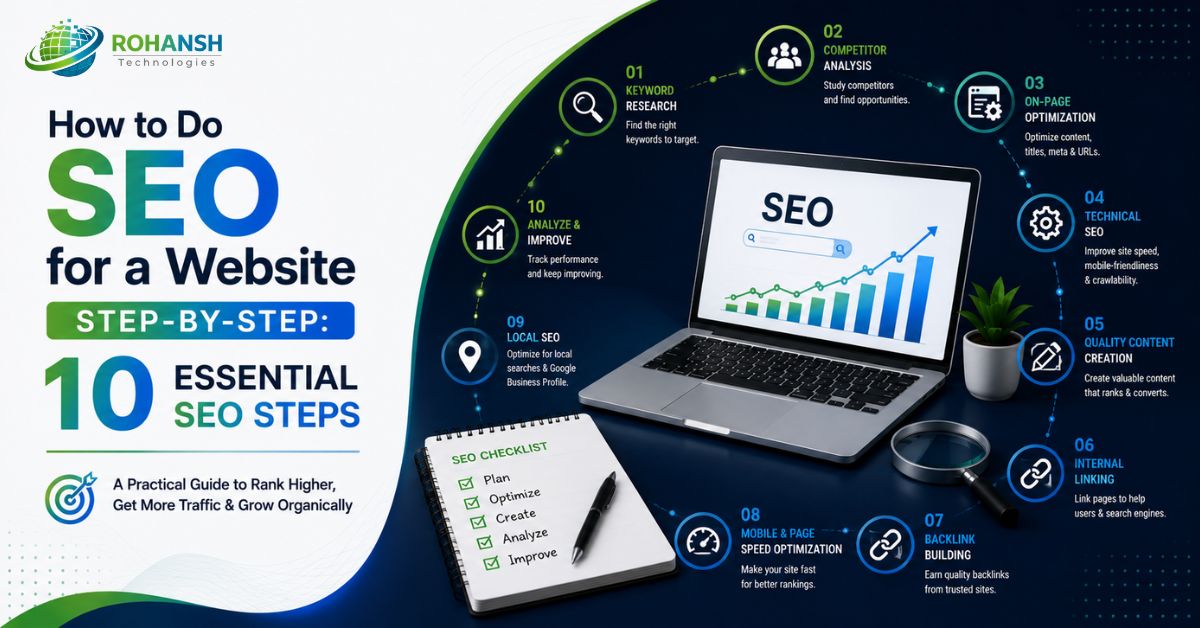
I've lost count of how many times a client has asked me why their competitor, whose website honestly isn't even that good, keeps outranking them. Nine times out of ten, it comes down to the same thing. SEO, done properly, in the right order. Not a magic plugin. Not one blog post that "goes viral." Just a series of steps, followed patiently, over several months. This guide walks through how to do SEO for a website step by step, the way I'd actually explain it to a business owner sitting across from me, not the way a textbook would.
So if you've been putting off learning how to optimize a website for SEO because the whole topic feels technical and a bit intimidating, take a breath. Broken into ten pieces, it's a lot more manageable than it looks from the outside.
Step 1: Know Where You're Starting From
Don't touch anything yet. Open Google Search Console. Open Analytics. Look at what's actually happening on your site right now: your current traffic, which pages Google has already indexed, and any keywords you're quietly ranking for without realizing it. I've seen people skip this and immediately start "optimizing" pages that were already performing fine, only to watch their rankings dip a few weeks later. A little patience here saves a lot of cleanup later.
Step 2: Actually Research Your Keywords
Everyone wants to skip this part and jump straight to writing. Don't. Find out, specifically, what your customers type into Google when they're trying to find something like what you sell. Google's Keyword Planner works fine to start; Ahrefs or SEMrush will get you deeper into volume and intent if you're willing to pay for it. Mix a couple of competitive, high-volume terms with a longer tail of more specific, easier-to-rank phrases. Everything else in this guide depends on getting this step right, which is really the whole point of improving SEO for website performance in the first place.
Step 3: Sort Out the Technical Side
Now check the plumbing. Technical SEO basically means making sure Google's crawlers can actually reach, read, and index your pages without tripping over something broken. Go through and look for dead links, pages that load too slowly, a sitemap that's outdated or missing entirely, duplicate content, and anything that looks off on mobile. Google indexes mobile-first these days. If your site feels clunky on a phone screen, that's not a small detail you can put off; it's actively hurting you. Better to fix this before you sink hours into content that people (and Google) can barely reach.
Step 4: Get the On-Page Details Right
This is where the hands-on work really starts. Write title tags and meta descriptions people would actually want to click, not robotic keyword strings. Use your headers (H1, H2, H3) to structure the page logically rather than stuffing them because a checklist told you to. Keep your URLs short and human-readable; something like /seo-guide/ tells a person and a search engine a lot more than a jumble of numbers and parameters ever could. Add alt text to your images. Link to other relevant pages where it makes sense. Let your keyword show up naturally, especially near the top of the page. None of these are hard on their own. It's doing them consistently, across every page, that actually moves the needle.
Step 5: Clean Up Your Site Structure
A site that's organized well is easier for a visitor to browse and easier for Google to make sense of. Group related pages together instead of scattering them randomly. Link between them where it genuinely helps the reader move forward, not just because you're trying to hit a link count. For instance, someone reading about SEO basics might also be curious about what is AI powered SEO, or want a clearer picture of how AI is changing SEO in 2026. Internal links serve two purposes here: they guide readers to more of what they need, and they pass some of your stronger pages' authority to newer ones still trying to earn their place.
Step 6: Write Something Worth Reading
Content is still the backbone of all this. That much hasn't changed, no matter how many updates Google rolls out. What has changed is how obvious it's become when content is written purely to satisfy a keyword tool rather than an actual person. Google's gotten noticeably better at recognizing thin, generic writing with no real point of view, and content that's clearly AI-generated with no human editing behind it tends to get filtered out fast now. Write it the way someone who's actually done the thing would write it. And if you're a newer company still figuring out where to even begin, putting together a rough SEO strategy for startups early can save you months of wasted effort down the line.
Step 7: Make It Fast
Nobody sticks around for a slow site anymore. They just leave, often without you ever knowing why. Core Web Vitals measure how quickly your pages load, how fast they respond when someone clicks or taps, and whether the layout jumps around while loading (which is more annoying than people admit). Compress your images. Cut scripts you don't actually need. Turn caching on. Choose hosting that won't buckle the moment traffic picks up. A slow page pushes people away before they've even seen what you wrote, and that bounce sends Google a signal you don't want it getting.
Step 8: Earn Links, Don't Buy Them
Backlinks are still one of the heavier ranking factors out there, right behind content itself. But it's shifted from a numbers game to a trust game. One mention from a genuinely respected site in your industry outweighs fifty links from directories nobody's ever heard of. Guest posts, digital PR, real relationships with other people in your space- these tend to work. Buying links off some marketplace or joining a link farm? That's the kind of shortcut that gets you penalized rather than ranked, and it's rarely worth the risk.
Step 9: Don't Ignore Local SEO
If you're serving customers in a specific town or region, this part matters more than people give it credit for. Set up your Google Business Profile and actually fill it out completely; don't leave half of it blank. Keep your name, address, and phone number identical everywhere they show up online; inconsistencies here confuse Google more than you'd think. Ask happy customers to leave reviews. A lot of local searches end in a decision within minutes, so showing up in that map pack can matter just as much as your regular rankings.
Step 10: Keep an Eye on the Numbers
SEO isn't something you finish and walk away from. Check Search Console and Analytics regularly, not once a year when someone reminds you. Notice which keywords are climbing, which pages are quietly losing traffic, and adjust based on what's actually happening rather than what you assumed would happen going in. Algorithms shift constantly, and honestly, this is usually the point where a lot of business owners realize a DIY approach only gets them so far.
A Note on Timing, Because People Always Ask
Set your expectations early. Most sites see initial indexing within the first month, some early movement in rankings around month three, and results you can actually point to by month six. That's roughly how it tends to go, give or take. Paid ads stop working the second you stop paying for them. SEO doesn't work like that. The effort you put in now keeps paying off long after you've moved on to something else, which is exactly why it rewards patience more than almost anything else in marketing.
And Search Itself Is Changing Too
Worth mentioning before we wrap up: search is shifting under everyone's feet right now. AI-generated summaries are showing up above the usual list of blue links for a lot of searches, pulling information straight from pages across the web. Ranking well isn't purely about the click anymore; it's increasingly about being the source those AI answers actually pull from. If you're thinking seriously about where SEO is headed over the next couple of years, that shift is worth keeping in the back of your mind.
Frequently Asked Questions
How long does SEO actually take to show results?
Most sites start getting indexed within the first month; you'll usually notice some early movement in rankings around the three-month mark, and results you can genuinely point to tend to show up by month six. It varies by industry and how competitive your keywords are, but if someone promises you rankings in two weeks, be skeptical.
Can I do SEO myself, or do I need to hire someone?
You can absolutely handle a good chunk of this on your own, especially the on-page and content side of things. Where it gets trickier is the technical work and ongoing link building; that's usually where people either run out of time or start making mistakes that cost them more than they save. A lot of businesses do a mix: DIY the basics, bring in help for the rest.
What's the difference between on-page and off-page SEO?
On-page SEO is everything you control directly on your own website, things like content, title tags, headers, and internal links. Off-page SEO happens elsewhere, mostly through backlinks and mentions from other sites. You need both. A perfectly optimized page with zero external trust signals still struggles to rank.
Does having a blog actually help my SEO?
Yes, but only if what you're publishing is genuinely useful. A blog gives you more opportunities to target relevant keywords and answer real questions your customers are searching for, which brings in traffic beyond just your core service pages. A blog full of thin, generic posts published just to "post something" won't move the needle much, though.
How much does professional SEO cost for a small business?
It varies quite a bit depending on your industry, your market's competitiveness, and how much work your site currently needs. Some businesses start with a smaller technical audit and build from there; others jump straight into an ongoing monthly strategy. It's worth getting a proper assessment of your site first rather than guessing at a budget, since a site with major technical issues needs a different starting point than one that's mostly solid already.
Wrapping This Up
Learning how to do SEO for a website step by step stops feeling overwhelming once you break it into pieces like this. Keyword research, the technical cleanup, solid content, real backlinks- each one builds on the last, and skipping one tends to make everything after it harder. You can genuinely do a lot of this yourself with enough time and patience. But SEO also rewards ongoing attention and a bit of experience, which is exactly why plenty of businesses eventually decide it's worth handing off to someone else.
If you'd rather spend your time running the business while someone else handles the strategy, it might be worth looking into the best SEO services for small business owners in your position. At Rohansh Technologies, we build strategies around your actual goals and industry rather than reusing the same template for everyone. If you're ready to turn your search visibility into something you can measure, get in touch with Rohansh Technologies and let's figure out what that looks like for your site.