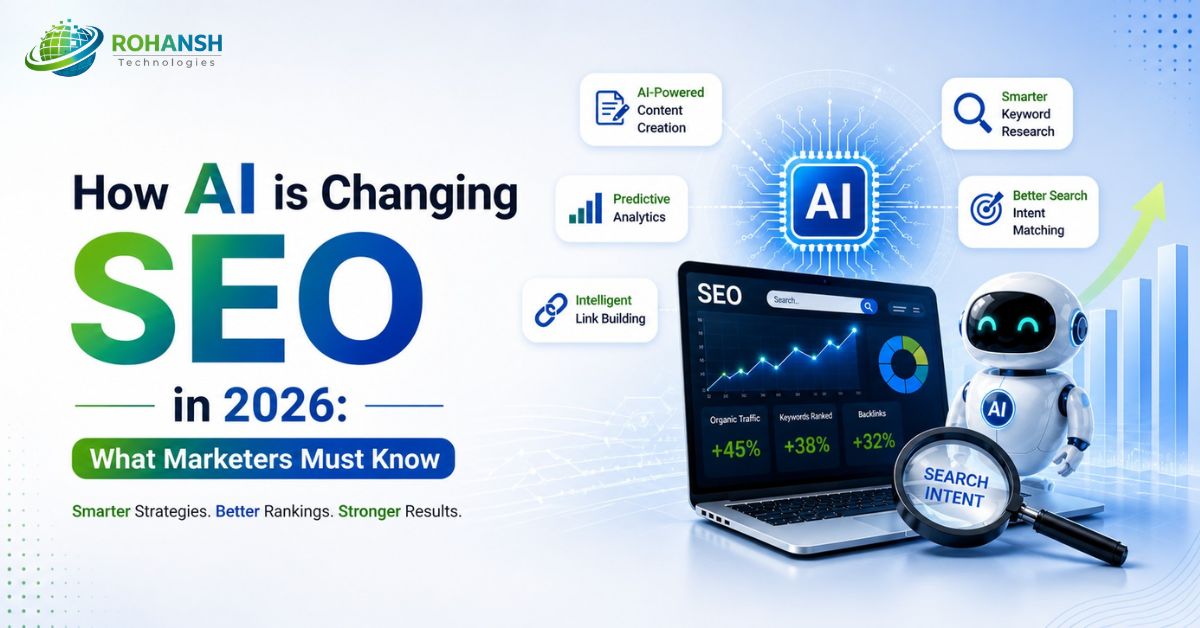
The Search Game Just Changed. Permanently.
If you’re basing your SEO strategy on keywords, backlinks, and page one rankings, then you’re already outdated. This clearly reflects how AI is changing SEO in 2026.
Because these things don’t cease to matter; the race just got longer.
It’s not about ranking on page one anymore in 2026. You need to be the answer, which is exactly how AI is changing SEO in 2026.
The answers generated by Google's AI Overview, ChatGPT search, Bing Copilot, and Perplexity are already being shown to millions of internet users even before they can see a single blue link on the SERPs. If your brand isn’t included in any of those answers, then it is invisible to huge chunks of your target market. This shift is a clear example of AI-powered SEO in action.
This isn’t an eventuality. This is reality.
And here’s the thing: this is what you really need to know about the future of AI in SEO in 2026, as well as how you should react to it.
Rankings No Longer Equal Visibility
Let's be blunt: you can rank #1 on Google and still lose traffic.
Google's AI Overviews now appear above organic results for an increasing share of queries. These are AI-generated summaries that pull from multiple sources and hand the user a direct answer, no click required, which is another way AI is changing SEO in 2026.
According to recent data, AI Overviews reduce organic click-through rates on the top result by an average of 34.5%.
This is the reality of zero-click search, and it's not going away.
What this means for you:
The metric that matters now isn't "am I ranking?" It's "am I being cited?" Getting mentioned inside an AI Overview, even without a click, is a brand trust signal that compounds over time, proving again how AI is changing SEO in 2026.
Two Completely Different SEO Jobs Now Exist
And that’s the most crucial strategic change that happened in 2026, yet most marketers view SEO as one role.
It’s not. It’s two:
SEO 1.0 – optimizing your content for people who read, compare, click, and purchase. Rankings, CTR, and user experience on your site. Still relevant.
AI SEO – feeding quality information to machines that will analyze, understand, and reference it – even when no user clicks on your content.
There are several terms for this – Generative Engine Optimization (GEO), Answer Engine Optimization (AEO), AI Overview Optimization, among others. The concept is the same. And if your strategy doesn’t include both, you’re missing out on half of the equation.
Content Quality Just Got a Harder Definition
For years, "quality content" was vague enough to mean almost anything. Not anymore.
AI systems evaluate content the way a rigorous editor would, looking for coherence, depth, verifiability, and contextual accuracy. Thin content written to satisfy algorithms is being filtered out at scale, which highlights how AI is changing SEO in 2026.
In 2026, the content that gets cited in AI-generated answers shares four traits:
- It answers a specific question directly and early, not buried after 400 words of preamble
- Original insights or data are included, rather than repeating information from other sources.
- It is structured for extraction clear H2s, bullet answers, TL;DR sections, FAQ blocks
- It is verifiable, cites sources, names studies, and references real numbers
Generic blog posts are a commodity. Expertise-driven, well-structured, answer-first content is what AI systems actually pull from.
AI Revolutionizes Keyword Research
Traditional keyword research focused on search volume and competitiveness. You identified your keyword, produced content based on it, and achieved your ranking.
AI has completely revolutionized the concept of “keyword research,” further proving how AI is changing SEO in 2026.
Today, modern AI tools no longer simply provide you with what people are searching for – they tell you why they’re searching, what they’re looking for, and how the query fits into an entire network of similarly intent-based groups.
This process is known as semantic search optimization and means:
- One content piece can rank for many related queries if it’s created within the right topic cluster, not just one keyword
- Conversational, long-tailed queries have never been more relevant since it’s how people communicate with AI virtual assistants and voice searches
- Intent matching beats keyword stuffing significantly in all updates
Stop writing content to rank for one keyword. Instead, write a comprehensive answer to one topic and let the AI tools determine its entire semantic cluster.
Complexity in Technical SEO Will Continue to Increase
What follows might seem odd at first, but here's a surprising truth: as AI technology makes on-page SEO tasks more straightforward, it is making technical SEO tasks increasingly difficult. This is another example of how AI is changing SEO in 2026.
Three technical SEO factors will become essential in 2026:
Structured Data (Schema Markup)
AI technologies use structured data to determine the meaning of a webpage. Schemas such as article, FAQ, HowTo, product, and credibility will be required features for SEO optimization.
Bot Management
With the emergence of AI crawler bots from OpenAI, Anthropic, Google, Perplexity, and other companies, managing bots with the help of robots.txt becomes a strategic issue rather than a purely technical one. Whose crawlers do you authorize to crawl your content and learn from it? What do you keep secret? It determines your visibility within AI technologies.
LLMs.txt
It is an emerging web standard used to direct AI crawlers in their interaction with a website and how they interpret its content. It functions similarly to the robots.txt file for traditional crawlers.
Brand Authority Is Now an SEO Signal
Google's algorithm has always rewarded authority. But in 2026, AI systems cross-verify your brand's signals across the entire web, not just your website. This reflects how AI is changing SEO in 2026.
This means your SEO strength is now tied to:
- How often your brand is mentioned on Reddit, LinkedIn, forums, and industry publications
- The consistency of your messaging across your website, social profiles, Google Business Profile, and third-party reviews
- Whether your business has original, proprietary content, research, case studies, or data that only you can produce
Brands with weak off-site presence are being hit harder by Google updates than ever before. Building brand authority is no longer a PR function; it's an SEO function.
Read Also: How to Generate Leads Through SEO: A Practical Guide for 2026
The Agentic Web Is Coming — And It Changes Everything Again
AI is moving from an answer engine to an action engine, another shift that is changing SEO in 2026.
AI is moving from being an answer engine to an action engine.
Agentic AI means AI systems don't just tell users which running shoes to buy, they find the right size, apply a discount code, and complete the checkout. No human browsing involved.
For SEO, this creates a new layer of optimization: machine readability and API compatibility.
If an AI agent can't read your product data, pricing, or inventory in real time, you won't exist in this new transaction layer.
This is early-stage, but the businesses preparing for it now will own a significant advantage when it becomes mainstream.
Hyperlocal SEO is The New SEO Trend Due to Personalization
AI technology has made search results highly personalized. This is another major way AI is changing SEO in 2026. Two different people searching for the same term in Delhi and Mumbai would get totally different results.
And for small businesses and startups, this presents itself as an opportunity, not a challenge.
This is because AI-based personalization favors specificity. A local business that understands its target customers, speaks in regional languages, addresses regional concerns, and has a robust Google Business Profile will do better than a national brand on AI-based localized search results.
Local SEO in 2026 goes far beyond "near me" keyword searches.
Actions You Should Take Right Now
Based on everything discussed, here is a practical to-do list you can implement immediately:
1. Audit your content for answer-readiness
Is your content answering questions in an informative manner close to the beginning of your web pages? If not, optimize your content structure. Include TL;DR sections, FAQ, and structuring using H2 headers.
2. Ensure you are implementing the missing schema
At the very least: Article, FAQ, HowTo, and LocalBusiness schema. Google has its Rich Results Test that can help.
3. Build a semantic keyword mapping instead of the keyword list
Organize your topics in groups. Create pillar content about each topic instead of writing one blog post for each individual keyword.
4. Start tracking AI citations instead of rankings
Tools like BrightEdge, SE Ranking, and Semrush start developing an AI Overview track. Start seeing if you appear in AI-based answers, not just the rank position.
5. Boost off-page brand signals
Make sure your company is referenced in all relevant discussion boards and industry publications. Collect reviews on Google, Yelp, and other platforms.
6. Optimize your Google Business Profile
This is the most important thing for any business and agency when it comes to 2026 SEO.
7. Write for humans first, then structure for machines
AI systems are sophisticated enough to detect content written purely to game algorithms. The highest-performing content in 2026 is genuinely useful, well-written, and structured in a way that makes it easy to extract and cite.
Bottom Line
AI hasn’t destroyed SEO. Instead, it’s elevated the stakes to the point where only quality, structured, and credible content makes the cut.
The companies that regard this new reality as a threat will continue pursuing increasingly irrelevant rankings. The companies that view it as an opportunity will create a lasting brand presence, build authority for their content, and gain AI traction that builds up over time.
The search bar in 2026 no longer returns links. It provides answers. Assesses credibility. Drives decision-making.
This isn’t about whether AI is disrupting SEO. This is about which brand ends up being the answer.
Rohansh Technologies helps small businesses and startups build SEO strategies that work in today's AI-driven search landscape. Get in touch to see how we can help you stay visible.
Frequently Asked Questions
1. Is SEO still valid in 2026?
Yes, but only in concert with AI Search Optimization (AEO/GEO). While rankings are the key to traffic, AI citations build credibility and zero-click views. Both are critical.
2. What is Generative Engine Optimization (GEO)?
GEO is how you format your content so AI-powered search engines such as Google's AI Overviews, ChatGPT Search, and Perplexity can correctly parse, contextualize, and quote your content in their results.
3. How do I see if my content is being quoted by AI Overviews?
Use tools such as BrightEdge, SE Ranking, or manually check your target keywords in Google without being logged in. See what kind of changes occur in the AI-generated responses.
4. Does AI content hurt SEO in 2026?
Not necessarily. Human-assisted AI content is acceptable, but not pure AI content with little value added by humans. Google has gotten really good at recognizing fluff. Insights, facts, and genuine authority are rewarded.
5. How crucial is schema markup to AI SEO?
Very crucial. Schema markup is one of the few means through which AI can recognize what your content is about and whether it has enough credibility to be cited.