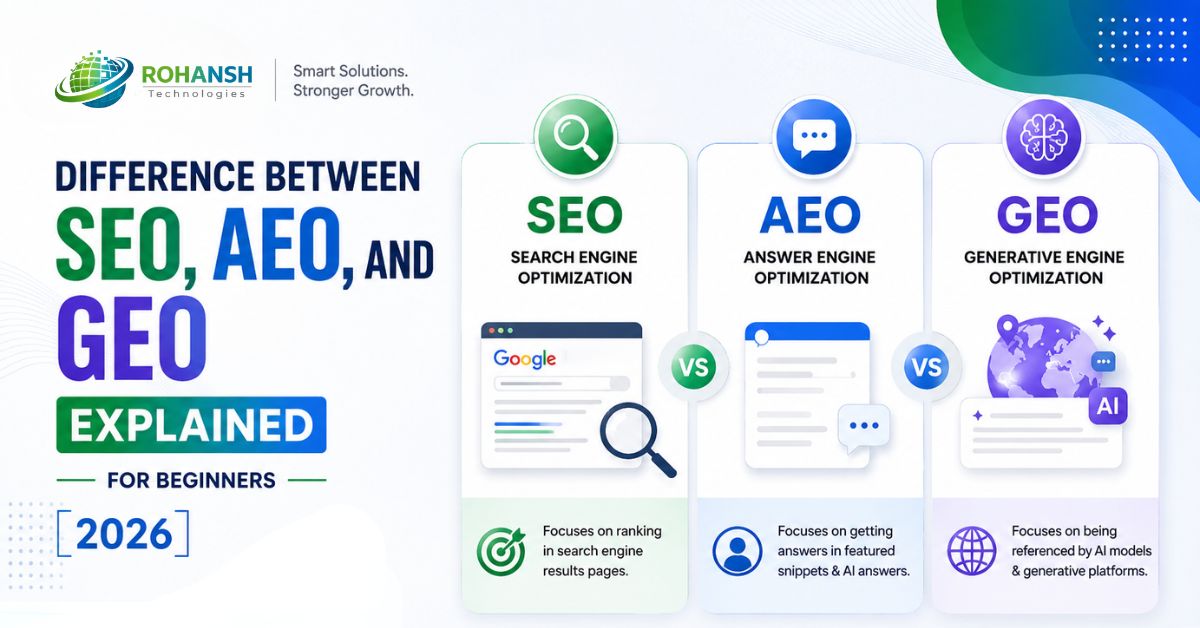
Three acronyms. One confused marketing team.
If you've been hearing the terms SEO, AEO, and GEO thrown around in 2026 and aren't entirely sure what separates them — or whether you need to care about all three — this guide is written for you.
Not for SEO professionals who've been deep in the weeds. For business owners, startup founders, marketers, and content creators who want to understand the difference between SEO, AEO, and GEO clearly, practically, and without the jargon fog.
Here is what's actually happening: the way people search for information has fundamentally changed. Google is no longer just a list of blue links. ChatGPT processes 2.5 billion prompts every single day — 65% of which function as search queries. Perplexity, Google AI Overviews, Gemini, and Bing Copilot are generating direct answers without sending users to websites at all.
The result? Over 60% of Google searches now end without a click to a third-party website — and AI-generated answers are accelerating this shift.
If your entire digital strategy is built around traditional rankings, you are optimising for a shrinking slice of the total search landscape. Understanding SEO vs AEO vs GEO is no longer optional for anyone who wants their brand to remain visible in 2026.
Let's break it down — clearly, completely, and in plain English.
What is SEO? (And Why It Still Matters in 2026)
SEO — Search Engine Optimisation — is the practice of improving your website's content, structure, and authority so it ranks higher on search engines like Google and drives organic traffic.
This is the discipline most marketers are familiar with. It includes:
- Keyword research — identifying what your audience searches for and creating content around those terms
- On-page optimisation — using target keywords in your titles, headings, meta descriptions, and body content
- Technical SEO — site speed, mobile-friendliness, Core Web Vitals, crawlability, structured data
- Link building — earning backlinks from authoritative websites to signal trust and relevance
- Content quality — creating genuinely helpful, experience-driven content that satisfies search intent
SEO remains one of the most powerful digital marketing strategies because organic search drives the majority of website traffic, it helps smaller websites compete with larger brands, and it builds credibility by ranking at the top of search results.
The critical point in the SEO vs AEO vs GEO conversation: SEO is the foundation. GEO and AEO enhance rather than replace SEO — generative engines rely on many of the same authority and relevance signals that traditional search algorithms use. You cannot build effective AEO or GEO on a weak SEO foundation.
AEO and GEO cannot compensate for fundamental SEO problems. If your site has poor Core Web Vitals, thin technical implementation, or content that Google can't crawl properly, adding FAQ schema and answer-format paragraphs won't rescue your AI visibility.
Who SEO is primarily optimising for: Google, Bing, and traditional search engines
What success looks like: Higher rankings, increased organic click-through rates, more website traffic
Primary metric: Keyword rankings, organic sessions, CTR
What is AEO? (Answer Engine Optimisation)
AEO — Answer Engine Optimisation — is the practice of structuring your content so it gets selected and surfaced as a direct answer in AI-powered search features, voice assistants, and zero-click results.
Rather than focusing on clicks to your website, AEO prioritises inclusion in answers directly on the results page. This zero-click solution may be delivered through features like AI Overviews or voice assistant responses — a position known as Position Zero.
Think about the last time you asked Google a question and got the answer right at the top of the page — before a single link. That box, that summary, that voice response — that's AEO territory. Your goal is not just to rank on the page. Your goal is to be the answer on the page.
What AEO optimises for:
- Google's AI Overviews (the AI-generated summaries appearing above organic results)
- Featured snippets and "People Also Ask" boxes
- Voice search responses (Google Assistant, Siri, Alexa)
- Knowledge panels and direct answer boxes
What AEO requires in practice:
- Answer-first content structure — your page must answer the target question clearly within the first 100–150 words
- FAQ sections — structured question-and-answer blocks that directly address "People Also Ask" queries
- Schema markup — FAQ schema, HowTo schema, Article schema — structured data that helps AI systems extract and display your content accurately
- Conversational language — content written the way people actually ask questions, not the way they type keywords
- Concise with depth — short, precise answers supported by detailed explanations
AI-driven visitors from AEO convert 4.4 times higher than traditional organic traffic. Being cited in AI answers builds instant credibility and positions your brand as a trusted source.
Understanding the difference between SEO, AEO, and GEO here: SEO is about winning traffic through rankings. AEO is about winning the answer box — often without a click. The tradeoff is intentional. You sacrifice some click-through traffic in exchange for being established as the definitive, trusted answer in your space.
Who AEO is primarily optimising for: Google AI Overviews, voice assistants, featured snippets
What success looks like: Appearing in answer boxes, PAA results, voice responses — even with zero clicks
Primary metric: AI Overview impression rate, featured snippet ownership, zero-click visibility
Read Also: What is AI-Powered SEO? A Complete Guide to How It Works
What is GEO? (Generative Engine Optimisation)
GEO — Generative Engine Optimisation — is the practice of structuring your content and digital presence so that AI-powered platforms cite, reference, or mention your brand when users ask questions.
GEO is the practice of structuring content and digital presence so that AI-powered platforms cite, recommend, or mention a brand when users ask questions. These platforms include ChatGPT, Google AI Overviews, Google Gemini, and Perplexity.
This is the newest layer of the SEO vs AEO vs GEO framework — and the one most marketers are still catching up with.
Here's what makes GEO different from both SEO and AEO: AI systems don't just rank pages — they retrieve, combine, and generate answers using multiple sources. They pull content using retrieval systems (RAG — Retrieval-Augmented Generation), extract key statements, data points, and explanations, then synthesise a response.
When ChatGPT or Perplexity answers a question, it isn't showing you one ranked page. It is synthesising information from dozens of trusted sources and producing a composed response. GEO is the discipline of making your brand, content, and expertise one of those trusted sources.
What GEO optimises for:
- ChatGPT Search and ChatGPT's browsing functionality
- Perplexity AI responses
- Google Gemini conversations
- Microsoft Bing Copilot
- Claude and other conversational AI platforms
What GEO requires in practice:
- Entity authority — your brand must be a clearly defined, consistent entity across the web. Consistent name, address, description, and positioning across your website, LinkedIn, Wikipedia (if applicable), social profiles, and directories
- Citation density — your content must reference credible external sources, original data, and verifiable claims that AI systems can trust
- Multi-platform presence — Reddit, LinkedIn, and YouTube ranked among the most-referenced domains by major large language models in 2025. Being present in conversations on these platforms directly influences how AI systems represent your brand
- Original data and research — AI systems prioritise content with unique, citable data over content that aggregates existing information
- Authorship and credibility signals — author bios with credentials, publication dates, cited sources, and organisational authority schema
According to Gartner, a 50% decline in conventional search traffic is predicted by 2028, with that volume migrating entirely to generative engines. Companies investing in GEO strategies are capturing disproportionate visibility during the critical 2026–2028 transition period.
Who GEO is primarily optimising for: ChatGPT, Perplexity, Gemini, Claude, and other LLM-based platforms
What success looks like: Brand citations inside AI-generated responses, brand mentions in synthesised answers, and AI referral visibility
Primary metric: AI citation share, brand mention rate in AI responses, and AI Overview impression rate
SEO vs AEO vs GEO: The Complete Side-by-Side Comparison
Understanding the difference between SEO, AEO, and GEO becomes clearest when you see them side by side.
| Factor | SEO | AEO | GEO |
| Full Name | Search Engine Optimisation | Answer Engine Optimisation | Generative Engine Optimisation |
| Primary Goal | Rank high, drive clicks | Be the direct answer | Be cited by AI systems |
| Target Platform | Google, Bing | AI Overviews, Voice Search, PAA | ChatGPT, Perplexity, Gemini, Claude |
| Success Metric | Rankings + organic traffic | Featured snippet ownership + zero-click visibility | AI citation frequency + brand mention rate |
| Key Tactics | Keywords, backlinks, technical SEO | FAQ schema, answer-first content, structured data | Entity authority, original data, multi-platform presence |
| Traffic Impact | High click-through traffic | Reduced clicks, higher visibility | Low direct clicks, high brand reach |
| Foundation Required | Standalone discipline | Requires a strong SEO base | Requires both SEO + AEO base |
| Maturity | Established (30+ years) | Emerging (2022–present) | Very new (2024–present) |
The Relationship Between SEO, AEO, and GEO: They Are Not Alternatives
This is the most important thing to understand about the difference between SEO, AEO, and GEO — they are not competing strategies. They are complementary layers of a complete modern search visibility strategy.
GEO and AEO aren't replacing SEO. They're building on their core goal of making your content easy to find, understand, and trust. The difference now is that "findable" means more than just ranking on Google — it means showing up wherever your audience is searching.
Think of it as a pyramid:
SEO is the foundation. Without technical health, crawlability, and domain authority, neither AEO nor GEO will perform. Research from Semrush shows that AI-generated answers often pull from content that already ranks highly in Google search results — suggesting there's overlap between what Google considers high-quality content and what generative models are more likely to cite.
AEO is the middle layer. Once your SEO foundation is solid, AEO tactics — structured content, FAQ schema, answer-first formatting — ensure your content earns the direct answer positions in Google's AI-powered features.
GEO is the strategic layer on top. GEO requires the technical authority built through SEO, the answer clarity developed through AEO, and adds a third layer unique to generative engines: entity authority, citation density within content, multi-platform distribution, and consensus signals. A GEO strategy is not SEO + AEO + some extras. It is a distinct discipline with its own requirements.
The businesses winning at AEO and GEO in SEO in 2026 are not choosing between the three. A multi-faceted search programme captures organic traffic through SEO, zero-click and voice searches through AEO, and visibility in AI-generative responses through GEO.
At Rohansh Technologies, we build integrated search strategies that cover all three layers — helping your business stay visible wherever your customers are searching. Exolore our SEO services to see how we approach modern search visibility.
Read Also: How AI is Changing SEO in 2026: What Marketers Must Know
The Real-World Difference: Three Scenarios
Scenario 1: Someone searches "best digital marketing agency for startups in Delhi"
- SEO gets you to page one for this query — someone clicks your link
- AEO gets you into the AI Overview at the top of that same SERP — your brand appears even if they don't click
- GEO gets you cited when someone asks ChatGPT or Perplexity the same question — your brand appears in the AI's generated answer
All three serve the same customer at different touchpoints in the same search journey.
Scenario 2: Someone asks Perplexity, "Which startup SEO agency in India should I contact?"
Only GEO applies here. There are no blue links, no featured snippets — only a synthesised AI response. If your brand doesn't have the entity authority, citation signals, and multi-platform presence that GEO requires, you simply don't exist in this answer.
Scenario 3: Someone asks Google Assistant on their phone, "How do I improve my website's SEO?"
Only AEO applies. Voice results pull one answer from one source. If your content is structured for direct answers with a clean FAQ schema, you have a chance to be that source. If it's not, you won't appear regardless of your traditional rankings.
This is why understanding AEO and GEO in SEO as complementary — not separate — disciplines is the key strategic insight of 2026.
How to Start Implementing All Three: A Practical Beginner Roadmap
You don't need to master all three simultaneously. Build in sequence.
Phase 1: Fix Your SEO Foundation (Months 1–2)
Before touching AEO or GEO, ensure:
- Your site passes Core Web Vitals (LCP under 2.5s, CLS under 0.1)
- Google Search Console is set up, and your sitemap is submitted
- Your site is on HTTPS and is fully mobile-responsive
- Your most important pages have clear, keyword-targeted title tags and meta descriptions
- Your content is genuinely helpful, well-structured, and written for your audience
Phase 2: Add AEO Tactics to Existing Content (Months 2–3)
Once SEO is solid, layer in AEO optimisation:
- Add FAQ sections to every blog post, targeting "People Also Ask" questions for your keyword
- Restructure your content so the answer to the target question appears within the first 100–150 words
- Implement Article schema using your SEO plugin (AIOSEO, Yoast, or RankMath)
- Write in clear, conversational language that mirrors how people actually ask questions
- Use the HowTo schema on instructional content and process-based posts
Phase 3: Build GEO Authority (Months 3 Onward)
With SEO and AEO in place, begin building GEO signals:
- Ensure your brand is described consistently across your website, LinkedIn, Google Business Profile, and all directories
- Claim your Google Knowledge Panel if eligible
- Add the Organization schema to your homepage, defining your brand's name, URL, logo, description, and contact information
- Start building original data — surveys, reports, case studies — that other sites and AI systems can cite
- Build author bios with real credentials on every piece of content you publish
- Be present in conversations on Reddit, LinkedIn, and relevant industry forums — AI systems learn brand reputation from these sources
- Earn mentions and links from reputable publications in your niche
If this feels like a significant undertaking, that's because it is — but you don't have to do it alone. Rohansh Technologies builds complete search visibility strategies covering SEO, AEO, and GEO for startups and small businesses. Speak to our team and let's map out what this looks like for your business.
What Metrics to Track for Each Discipline
Tracking SEO vs AEO vs GEO performance requires different tools and different KPIs.
For SEO:
- Keyword rankings (Semrush, SE Ranking, Ahrefs)
- Organic traffic and click-through rate (Google Search Console, GA4)
- Domain authority and backlink growth (Ahrefs, Moz)
- Core Web Vitals scores (Google PageSpeed Insights, GSC)
For AEO:
- AI Overview impression rate (Google Search Console — "Search Appearance" filter)
- Featured snippet ownership for target keywords
- "People Also Ask" appearance frequency
- Voice search visibility (SE Ranking has a dedicated voice search tracker)
For GEO:
- AI citation share — how often your brand appears in ChatGPT, Perplexity, and Gemini responses for relevant queries (manually test and track, or use emerging tools like Profound, SE Ranking's AI visibility feature, or BrightEdge)
- Brand mention rate in AI-generated answers
- Referral traffic from AI platforms (visible in GA4 as traffic sources from chat.openai.com, perplexity.ai, etc.)
If you're only tracking organic sessions and keyword rankings, you're flying blind in 2026. You need to add AI citation share, AI Overview impression rate, zero-click impression value, and assisted conversion attribution from AI-driven discovery.
Common Mistakes Beginners Make With SEO, AEO, and GEO
Mistake 1: Treating them as alternatives
The most common misconception in the SEO vs. AEO vs. GEO conversation is believing you have to choose one. You don't. You stack them in sequence.
Mistake 2: Jumping to GEO without an SEO foundation
Publishing entity-rich, AI-optimised content on a technically broken website achieves nothing. Fix the foundation first.
Mistake 3: Publishing volume over structure for GEO
Publishing 100 new articles because someone said "GEO needs content" is the most common and most wasteful response to the new landscape. What matters is how well each piece of content is structured, cited, and distributed. Ten well-constructed, entity-rich, authoritatively cited pieces will outperform 100 keyword-stuffed blog posts in AI visibility every single time.
Mistake 4: Ignoring authorship and credibility signals
Brands spend enormous resources on content production and keyword optimisation, then publish everything under "Admin" with no author bio, no credentials, no cited sources, and no organisational authority signals. In 2026, this is a fundamental visibility mistake.
Mistake 5: Measuring GEO with traditional SEO metrics
GEO performance doesn't show up in keyword rankings or session counts. If you're measuring GEO success by organic traffic alone, you'll incorrectly conclude it isn't working.
Frequently Asked Questions
Q: What is the main difference between SEO, AEO, and GEO?
The difference between SEO, AEO, and GEO comes down to what you're optimising for. SEO targets traditional search engine rankings to drive clicks. AEO targets direct answer positions — featured snippets, AI Overviews, and voice results — where users get answers without clicking. GEO targets citations inside AI-generated responses from platforms like ChatGPT and Perplexity, where AI synthesises answers from multiple sources. All three share foundational tactics but serve different discovery pathways.
Q: Do I need all three — SEO, AEO, and GEO — for my business?
Yes — but build them in sequence. Start with a solid SEO foundation, then layer AEO optimisation into your content structure, then build GEO authority through entity signals and original data. Skipping the sequence produces poor results at every stage. The difference between SEO, AEO, and GEO is not just technical — it reflects three different stages of search maturity that your strategy should progress through.
Q: Is GEO replacing SEO in 2026?
No. GEO is not replacing SEO — it is expanding it. Traditional SEO still drives the majority of website traffic for most businesses. What GEO addresses is the growing share of searches that never reach a website at all. Brands that only invest in traditional SEO are optimising for a shrinking piece of the search pie. The complete formula for SEO vs AEO vs GEO in 2026 is: SEO + AEO + GEO, not SEO or GEO.
Q: What do AEO and GEO in SEO actually mean for a small business?
For a small business, AEO and GEO in SEO mean three practical things: First, your content needs to be structured so AI systems can extract and use it (AEO). Second, your brand needs to be consistently defined and credible across the entire web so AI systems trust it (GEO). Third, your technical SEO foundation must be solid enough that AI crawlers can access and interpret your site at all (SEO). Together, they determine whether your business appears in the full modern search landscape — not just Google's blue links.
Q: How long does it take to see results from AEO and GEO?
AEO results — featured snippets and AI Overview appearances — can appear within four to eight weeks of implementing structured content and FAQ schema on well-ranking pages. GEO results are slower and harder to measure precisely; brand citation patterns in AI systems typically take three to six months to shift noticeably, and tracking requires dedicated AI visibility tools rather than standard SEO dashboards.
Q: What content types perform best across SEO, AEO, and GEO?
Research reports, data-driven articles, comprehensive FAQs, how-to guides, and structured comparisons perform well across both GEO and AEO optimisation strategies. Content that helps buyers make decisions is more critical than ever. For SEO, this same content also earns backlinks and organic rankings — making it genuinely the highest-ROI content format to invest in for any business that wants visibility across all three disciplines.
Q: Is there a single tool that tracks SEO, AEO, and GEO together?
Not completely — yet. For SEO and AEO, Google Search Console combined with Semrush or SE Ranking covers most tracking needs. For GEO specifically, tools like Profound, BrightEdge, and SE Ranking's AI visibility module are building out AI citation tracking. The landscape for GEO measurement tools is evolving rapidly, and consolidation is expected. For now, tracking all three requires a combination of tools monitored alongside each other.