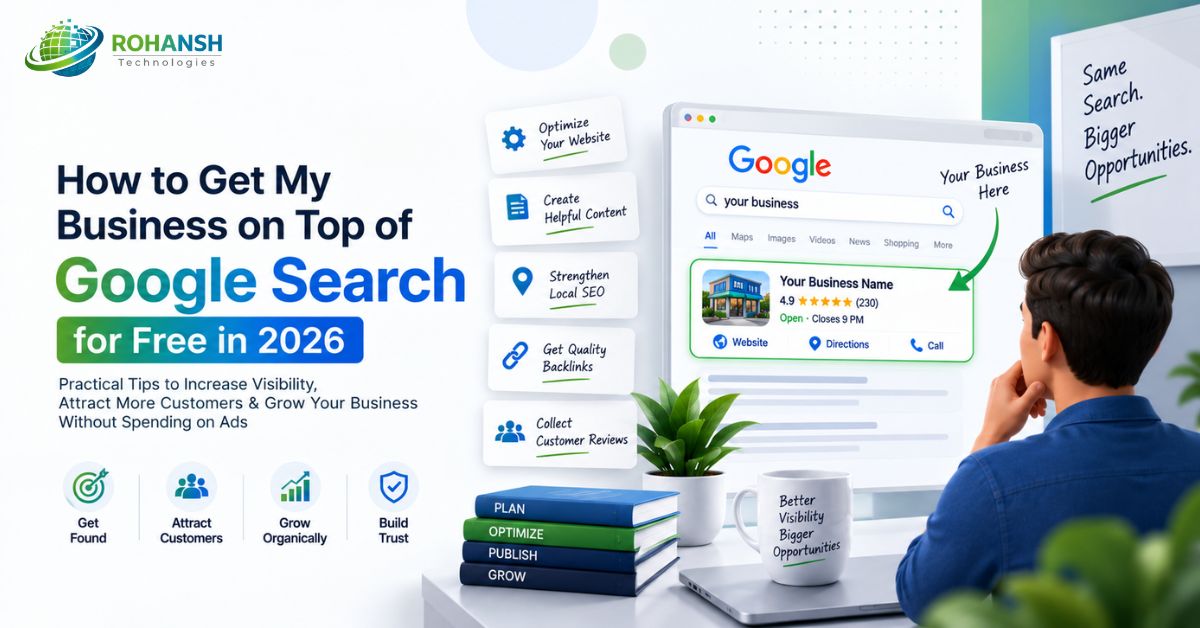
So you've typed "how to get my business on top of Google search for free" into Google itself, probably more than once, probably at odd hours. Fair enough. Paid ads burn through cash fast, and organic ranking can feel like it's controlled by some invisible committee that changes the rules every quarter. Here's the thing though, and it took me a while to actually believe this myself: Google's core ranking logic hasn't moved nearly as much as the SEO blogs want you to think.
Relevance, trust, decent user experience. That's still most of the game. This post covers how to make your website show up on Google first without spending a rupee on ads. Fair warning: none of it is a magic trick. It's mostly just doing the boring stuff properly and not quitting after two weeks. At Rohansh Technologies, we've watched small businesses pull this off with nothing but consistency and the right priorities, so everything below is stuff we've actually seen work, not just theory picked up from a blog somewhere.
Why Free Ranking Still Works in 2026
A lot of business owners have written off organic ranking entirely, blaming AI Overviews and ad blocks for eating the whole first screen. I get why people think that, but it's not really accurate. Google still needs actual, credible websites to power those AI answers, and it still needs somewhere to put the organic results once the ads run out. If you've looked into how to do SEO for a website step by step before, you already know visibility without an ad spend is still very much possible. What's changed is that the old tricks- keyword stuffing, sketchy link farms, buying backlinks in bulk- just don't work the way they used to. Which, weirdly, works in favor of smaller businesses now. You're not competing on budget anymore. You're competing on whether your site is actually useful.
Claim and Optimize Your Google Business Profile
If you've got a local business, do this one first, before anything else on this list. Claim your Google Business Profile and fill in literally everything: category, service area, hours, photos, the description field nobody bothers with. Profiles that are filled out and updated with new photos regularly tend to beat the half-empty ones sitting in the local map pack, which is the block that shows up above the regular organic results anyway. Post something weekly if you can manage it. Reply to every review, even the unfair two-star one from three years ago. And keep your name, address, and phone number identical everywhere: your site, your listings, your Facebook page, all of it. Small inconsistencies here confuse Google more than people expect.
Build a Technically Clean, Fast Website
A page Google can't crawl properly isn't going to rank, no matter how good the writing is. Get your load time under three seconds if you can, make sure it actually works on a phone (not just "looks fine," actually works), use HTTPS, and submit a proper sitemap through Search Console. Go find those broken links you've been avoiding and fix them. Kill off duplicate pages. Use URLs that describe what's on the page instead of some string of numbers your CMS generated. Compress images before uploading; don't load the page down with scripts that do nothing useful. Core Web Vitals really do factor into rankings, so this technical layer is the thing everything else stands on. This is also a good moment to think about a real SEO strategy for startups, because fixing this stuff early is a fraction of the cost of fixing it after the site's grown messy for three years. It's honestly one of the first things the team at Rohansh Technologies checks when a new client comes in, because no amount of good content saves a site that's technically falling apart underneath.
Do Smarter Keyword Research Without Paid Tools
You don't need a paid tool for this, not really. Autocomplete alone tells you a lot. So do the "People also ask" boxes and the related searches tucked at the bottom of the results page; most people scroll right past them. AI helps speed this along too; if you know how to use ChatGPT for keyword research, you can pull together long-tail keyword ideas and rough content outlines in a fraction of the time it used to take. Go after phrases that sound like what your customers actually type, something like "how can I make my website appear at the top in Google searches," instead of broad terms that every competitor with a bigger budget is already fighting over. Long-tail keywords are less crowded, and honestly, they convert better too, because whoever's typing that specific phrase already knows roughly what they want.
Create Content That Actually Answers Search Intent
Once you know what people are searching for, answer it fully, on one page, without making them click through five tabs to piece the answer together. Google clearly favors pages that actually resolve the question over thin content that exists mostly to funnel clicks elsewhere. Break things up with headings, keep the paragraphs from turning into walls of text, and use bullets where they genuinely help rather than just to look organized. Add real examples if you have them, or your own experience, Google's helpful-content systems are decent now at telling apart generic, recycled filler from something written by someone who's actually done the thing. And don't only publish new stuff; go back to old posts and update them. Refreshing numbers, tightening a paragraph, cleaning up formatting on an existing page often moves rankings faster than a brand-new post ever would.
Earn Backlinks Without Spending Money
Backlinks still carry real weight, and no, you don't have to pay for them. Guest post on blogs that actually overlap with your industry. Get listed in free local directories, niche ones too, not just the big obvious ones. Trade links naturally with other business owners you actually know and trust, not some random link exchange scheme. Answer questions on Reddit or Quora properly, with a link only when it genuinely fits, not bolted on. Local press coverage, especially anything tied to community work or a story worth telling, is another free route to backlinks that keep paying off years later.
Use On-Page SEO Correctly
This is where a lot of small businesses either win or quietly disappear from search results, and none of it costs anything but time. Work your target keyword into the title tag, meta description, H1, and somewhere in the first hundred words, naturally, not forced. Write actual descriptive alt text instead of leaving it blank. Link related pages to each other internally. Add schema markup where it fits; review schema or FAQ schema are easy wins. Don't repeat your keyword five times hoping it helps; Google's pretty good at catching that now, and it tends to backfire. Being consistent site-wide, not just on the homepage, is what slowly builds the kind of topical trust Google rewards. It's a slow, unglamorous process, but it's exactly the kind of groundwork Rohansh Technologies leans on before touching anything flashier like backlink outreach or paid promotion.
Leverage Social Proof and Reviews
Reviews affect rankings more than most people assume, and they definitely affect whether someone actually clicks your result. A business with a steady stream of recent, detailed reviews just reads as more trustworthy, to people and to whatever Google's evaluating behind the scenes. Ask for reviews right after a good interaction, while it's still fresh, and make it easy with a direct link. Reply to reviews publicly, all of them, not just the glowing ones. Reviews on Facebook, Trustpilot, or wherever else your industry lives matter too, and this stuff carries even more weight in fields like health, finance, or legal, the kind Google treats more carefully because a bad recommendation there actually costs someone something.
When to Consider Getting Expert Help
You can do everything above yourself. Plenty of people do. But it takes real, ongoing time every single week, and if you're already stretched thin running the actual business, that's a lot to ask. If that's you, looking into the best SEO agency for small businesses might make sense, mainly because a decent one will prioritize whatever actually moves your specific numbers instead of guessing. This is where a team like Rohansh Technologies tends to earn its keep, not by reinventing SEO, but by running through exactly this checklist faster and catching what's not working before months get wasted on it. Whichever route you pick, the underlying principles don't change.
Frequently Asked Questions
1. How long does it take to rank on Google for free?
Local results can shift within a few weeks once your Business Profile is properly filled out, but competitive organic keywords usually take three to six months of steady work before you notice real movement.
2. Can I rank on Google without a blog?
You can, technically, but a blog makes it a lot easier. It gives you more room to target long-tail phrases, answer specific customer questions, and link back to your core service pages.
3. Is Google Business Profile enough for local SEO?
It's the biggest single piece, but not the whole thing. You still need matching NAP details across directories, a steady flow of reviews, and a site that actually works on mobile.
4. Do I need backlinks if my content is really good?
Good content carries you part of the way, but backlinks are still a strong trust signal. Without any, even solid content often struggles against competitors who already have a head start there.
5. How often should I update my website content?
Somewhere around every three to six months works well for most sites, refreshing numbers, examples, and phrasing to keep pages aligned with what people are actually searching for now.